Wednesday, June 29, 2016

Driving through Cairngorms National Park

It was a great drive through the Cairngorms National Park.  We thought we were going to have to take a detour out of the park because of road construction, but they ended at 4:00 and we got to the closed section of the road at 3:30, so we turned around and had tea at a local place and waited for the road to open.  It was worth it.  The afternoon had been pretty rainy, so there were dark clouds across the sky.  We climbed to a max elevation of 2100 feet, then came back down.  The views of the rocky craigs were magnificent.

If a road in a national park in the US were closed for a while, there would be a tremendous line waiting to go through.  Today there was only us going up the hill after 4:00.  Everyone else either found another way, wasn't passing this direction (and/or the kids were not out of school yet so people were not vacationing).
 Scott is our stalwart driver and "Thistle" (a hairy highland coo or cow) is our navigator's aide.
The Scotland Broome (yellow flowering bushes) were so bright, especially on a gray day.  There were stretches of road with bright yellow on both sides.
Climb to the top of the pass. (You can see the snow poles on the sides, so it does get snowy here in the winter).  There was a ski resort at the top with about 8 lifts and tow lines.  It was kind of weird, it was above the timberline but the runs were in fenced in areas.

Cargorff castle in the valley (closed due to the road construction).


My kind of school bus

The kids are out of school here at the end of the week (last week in June), and so they are doing what many school kids do in the last week of school...taking field trips.  This group pulled up to the castles just after we arrived.  If you look closely, you can see a yellow School Bus attachment on the back end, but this is a classic London double decker!

Crathes Castle

Our first stop today was Crathes castle, not far from Balmoral castle.  The castle was built in the mid 1500s by the Burnett family and has been lived in by that family for 350 years.  The wing on the right is actually quite new, having been rebuilt after a major fire in the 1960s.  It was originally built over 100 years ago by one of the Lairds whose wife gave birth to 21 children in 22 years, so they needed more space in the castle!  In 1951, the 13th Baronet gave the castle over to the National Trust for Scotland.

During WWII the family volunteered it as a convalescent house for veterans.  There are two spiral staircases that run up the north and south sides of the building.  There are 4 main levels and several half levels (with lower ceilings).  The large window you can see below was added to the main living room (and makes me wonder if this is how they got furniture in given the smallness of the spiral stairs).

This castle actually felt like a home, with carpets on the floors, pictures (not ancient family portraits) on the walls, and was filled with furniture.
The gardens were beautiful and very well kept with a great view of the castle on the high ground.

Lots of views of the gardens below the castle.


We couldn't take pictures of the interior, so these are taken from the guide book.  Not as good as actual, but give you an idea any way.  Kitchen is below (on the first level).

Lady's bedroom (the quilt was made by one of the ladies of the house with snipets from her daughter's dresses.  The daughter died in child birth).
 Laird's bed.
  Upper most room- used as a library at one time.  Beautiful woodpaneled ceiling.
Two of the rooms had beautiful painted panel ceilings.  This is my one illicit photo since they weren't featured in the guide book:

Some of the sculpted yews were several hundred years old.


The oldest tree in the garden is in the very center.
This statue of a boy with a turtle on his back is very cute.

We got to the castle a little early and chose to walk around the forest trail.  LOTS of ferns and boggy spots.  Very pretty.
Can you find a four leaf clover?  Me neither.


Tuesday, June 28, 2016

Aberdeen Fairtrade City

The sign when we entered the city of Aberdeen read "Fair Trade City".  Evidence of this...on all the various sugar packets at the restaurants where we ate.  This will warrant a little more research on my part...


Monday, June 27, 2016

National Maritime Museum

Spent the afternoon at the Maritime museum.  It was not too big, but well done.  I didn't take too many pictures.  Aberdeen has a long history as a shipbuilding, fishing, and most recent oil city (from the North Sea).  All of this was well documented throughout the musuem.

I really liked this quilt that was on display.
A close up.  The fisher's seamed face is done with stitching.

This map shows all the deep sea oil activity in the North Sea.  (The orange is the land, Scotland)  It also had light up routes where the oil pipelines run as well as the gas pipelines.
A mock up of an oil rig.  They had a lot of ship and oil platform models.  They also had a video about the safety briefings for the oil rig workers who ride out by helicopter.  They have to put on dry suits and wear lifevests throughout the flight.  They also have to pass a safety test in a simulator of a helicopter crashing in the water.  They have to get out of the simulator safely.  Aberdeen airport is the busiest heliport in the world because of all the oil rig flights.


Dunottar Castle near Stonehaven

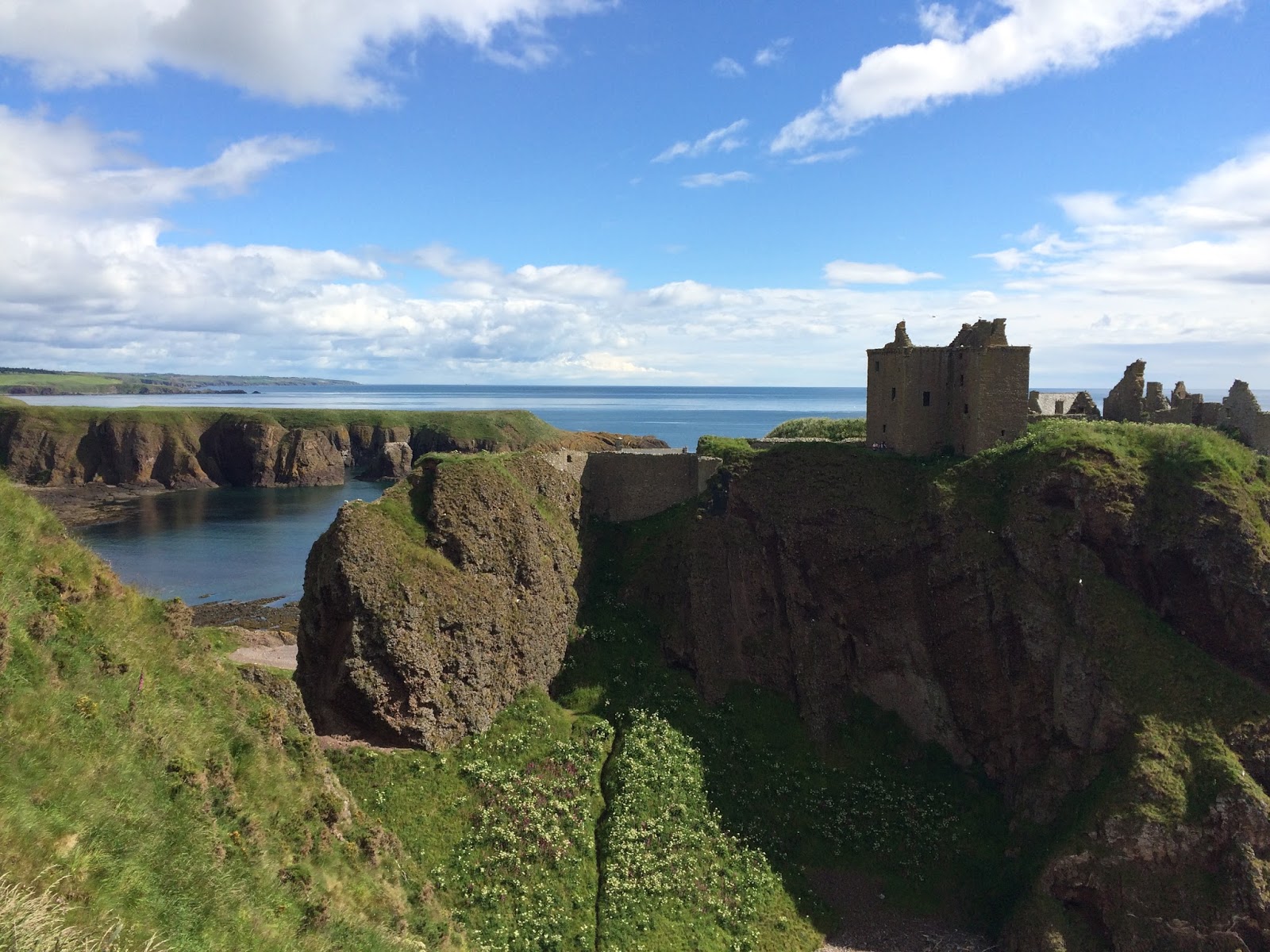
Couldn't have picked a nicer morning to visit Dunottar castle just south of Aberdeen.  This castle dates back to the 1400 and 1500s, but was a fortified location even before that.  It is not quite on an island, but is accessible only by going down a steep hill and up an steep narrow ridge with the castle fortifications directly above you.  Highly defensible.  The castle is most famous for keeping the Honors of Scotland (royal Scottish jewels and regalia) safe when Cromwell invaded in the 1600s.  Before the garrison surrendered (because Cromwell's artillery could level the castle), they managed to smuggle the jewels out of the castle and hide them buried at a local church.  They were restored when Charles II was restored to the throne several years later.

 This stream and small waterfall run past the cliffs of the castle into the North Sea.
The wildflowers on the slopes were beautiful.
 This is looking up from the sea shore.  You can just make out the gate at the bottom of the structure with the gate house looming over it.

 This is an overview photo (from the guide book).  You can see how much room there is on top of the plateau.  They even cultivated the land for the kitchens.
 The wooden beams were completed rotted away in the interior, but you can see the holes in the walls where the floor boards for 3 levels were.
The buildings are made of red sandstone which is pretty vulnerable to the weather and erosion.


 The views from the windows were magnificent.  I could have gazed out at them all day.


In 1685,  167 Presbyterians were held in the cellars for over 3 months.  They had refused to acknowledge that the king was the head of the church and were forced out of Edinburgh and held at Dunnottar.  Most died, the rest were transferred to Perth Scotland.
Water was supplied by a cistern.  It is approximately 20 ft deep!


 On the beach below the castle.  The area was once volcanic and the rocks and shoreline are very rough.